Know which competitor price changes deserve your attention.
Build a focused watchlist for the products that matter to your store. Anyweb assesses permitted data sources and creates a comparison view with product-match evidence, availability, shipping context and collection timestamps.
Free first look. Scope, connections and costs agreed before a production build.
OverviewRulesReview queue
Illustrative concept · Built around your business
Illustrative workspace, not live operating data
A CONCRETE FIRST LOOK
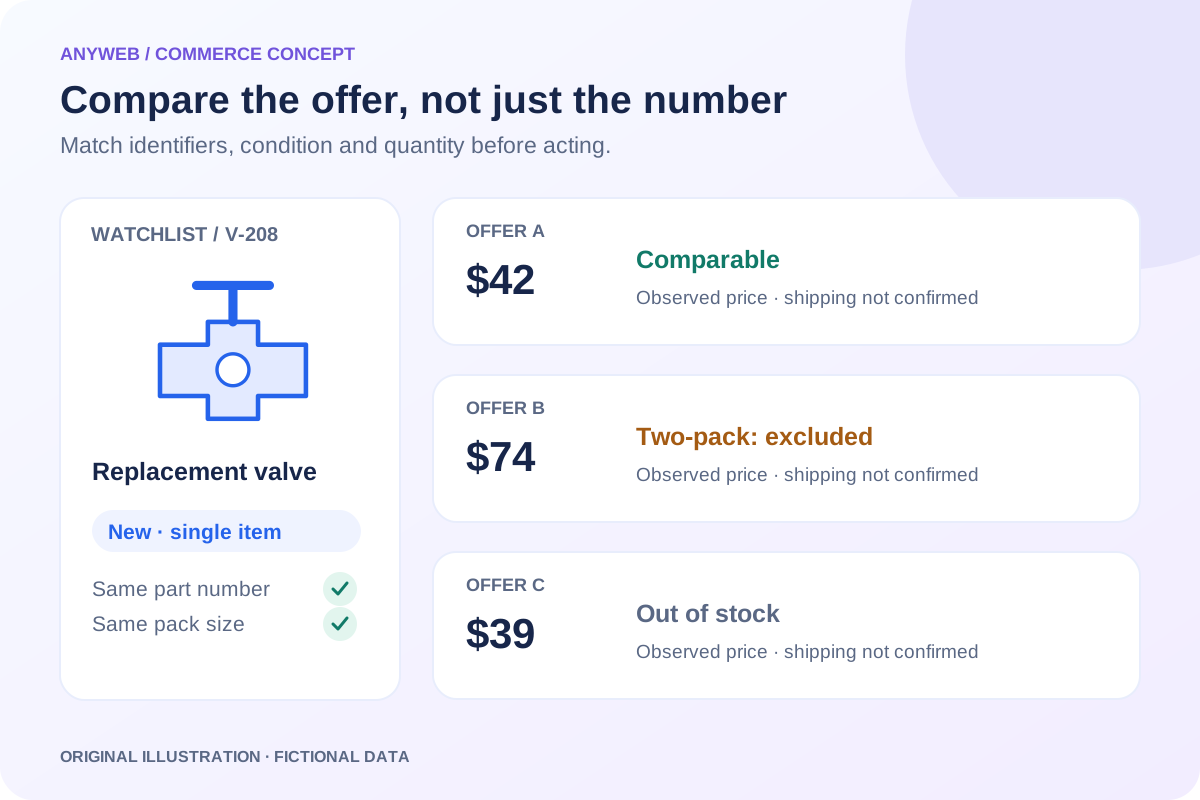
Fictional comparison for one replacement valve
Illustrative data, designed to make the workflow easier to discuss.
SAMPLE WORKSPACE
Fictional comparison for one replacement valve; fictional example data
Offer
Observed price
Status
Store A: one new valve
$42 USD
Matched; freight unknown
Store B: two-pack
$74 USD
Different quantity
Store C: one new valve
$39 USD
Out of stock
Invented offers explain comparison logic. These are not current competitor prices or complete market coverage.
Inspect a sample market observation
A useful comparison needs more than a lower number.
Ready for human comparison
The sample model and pack quantity match, and the observation is within its agreed age. Compare shipping, stock and terms before deciding.
Fictional observations. No competitor website is contacted, no live price is shown and no selling price is changed. Monitoring requires approved access and an agreed match policy.
01
Start with an intentional watchlist
Choose a product family or limited set of important SKUs before expanding. Define retailers, markets and currencies that matter to your customers. Existing monitoring software may cover standard requirements; custom development is useful when your identifiers and comparison rules need special handling.
02
Match the product before the price
Use UPC or manufacturer part number alongside variant, condition and pack quantity. Keep evidence behind each match and flag ambiguous items. A similar title is not enough when a newer revision or missing accessory changes the offer.
Variant and condition checks
Pack-size and included-item checks
03
Show the buying context
Record whether the compared item was available and whether shipping or membership conditions were visible. Display collection time and source link beside the price. Unknown freight remains unknown; it should not silently become free delivery in a comparison.
04
Keep monitoring separate from repricing
A daily review list may be all your team needs. Group changes by category, prioritize confidently matched offers and allow exclusion notes. If you later enable price updates, connect them to your own cost floors and approval rules rather than following every competitor downward.
FROM IDEA TO A WORKING PROCESS
A clear path through the work.
Each step makes the dependencies, decisions and handoffs visible.
01
Select a sample
Choose a small watchlist and the competing offers you want to understand.
02
Validate matches
Review identifier, condition, quantity and shipping differences before trusting alerts.
03
Review changes
See comparisons with freshness and excluded offers clearly marked.
REAL WORK. CLEAR CONTEXT.
Explore the relevant building blocks.
These references show related experience. The solution above is a proposed direction, and its exact scope is agreed for your project.
What is possible depends on your data, existing systems and the way your business works.
Can we monitor only best-selling products?
Yes. A narrow watchlist is a useful starting point. Decide which products and competitors matter, then expand after checking match quality and usefulness.
Will this automatically lower my prices?
No. Monitoring can be read-only. Automated repricing is a separate scope with your pricing rules, exclusions and approval requirements.
Can every competitor site be monitored?
No. Source permission, terms, accessibility and reliability must be assessed. We do not promise access to blocked, private or unsupported data.
How are false matches avoided?
Combine identifiers with pack size, condition and variant information, retain evidence, and route uncertain pairs to review instead of treating them as comparable.
Bring supplier costs, comparable market prices and defined margin calculations into one Shopify pricing workspace with freshness checks and approval controls.